EIF voltage traces and a recurrent network raster
13th May 2026
The same setup as nb000, but using exponential integrate-and-fire neurons in place of LIF.
The exponential integrate-and-fire (EIF) neuron is the natural next step up from LIF: same one-variable spirit, but with an explicit exponential term that models the upswing of a spike rather than a hard threshold-crossing rule.
The subthreshold dynamics are
with a peak-and-reset rule
Compared to LIF, the threshold is no longer a discontinuity: it is the soft inflection point at which the exponential term takes over and the membrane potential blows up on its own. The slope factor controls how sharply this transition happens — small approximates LIF, larger smooths the spike initiation.
The code integrates with forward Euler at ,
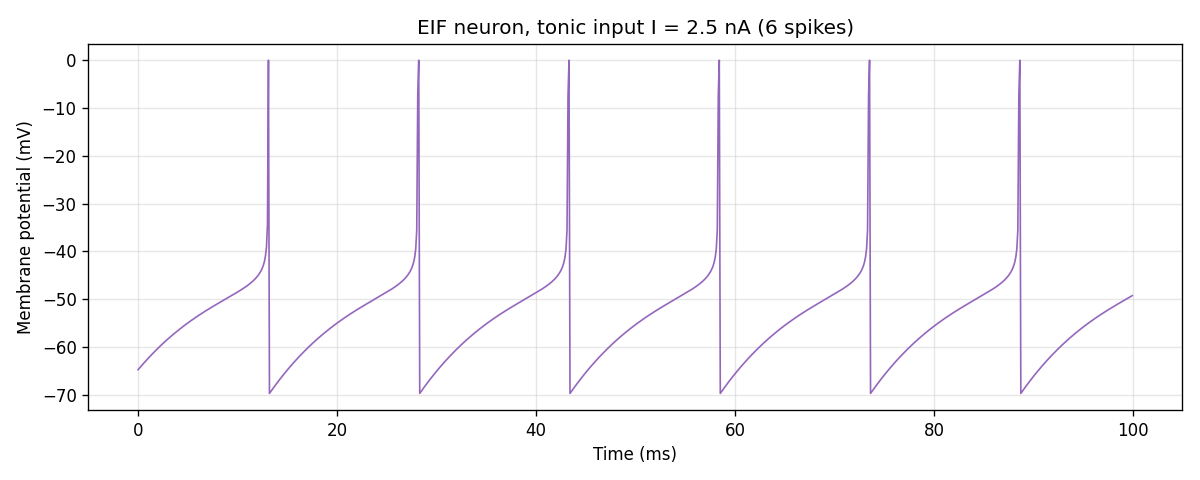
using , , , , , , , and tonic input .
With the same tonic input as nb000, the EIF neuron fires at a different rate than the LIF neuron — the exponential term accelerates spike initiation, but the upswing itself takes time, so the period between spikes shifts.
The network is structurally identical to nb000: 200 all-excitatory neurons, sparse random connectivity, weights , exponentially-decaying synaptic input with , noisy per-neuron bias , and a refractory period after each spike. The only difference is that every neuron now obeys the EIF dynamics above.
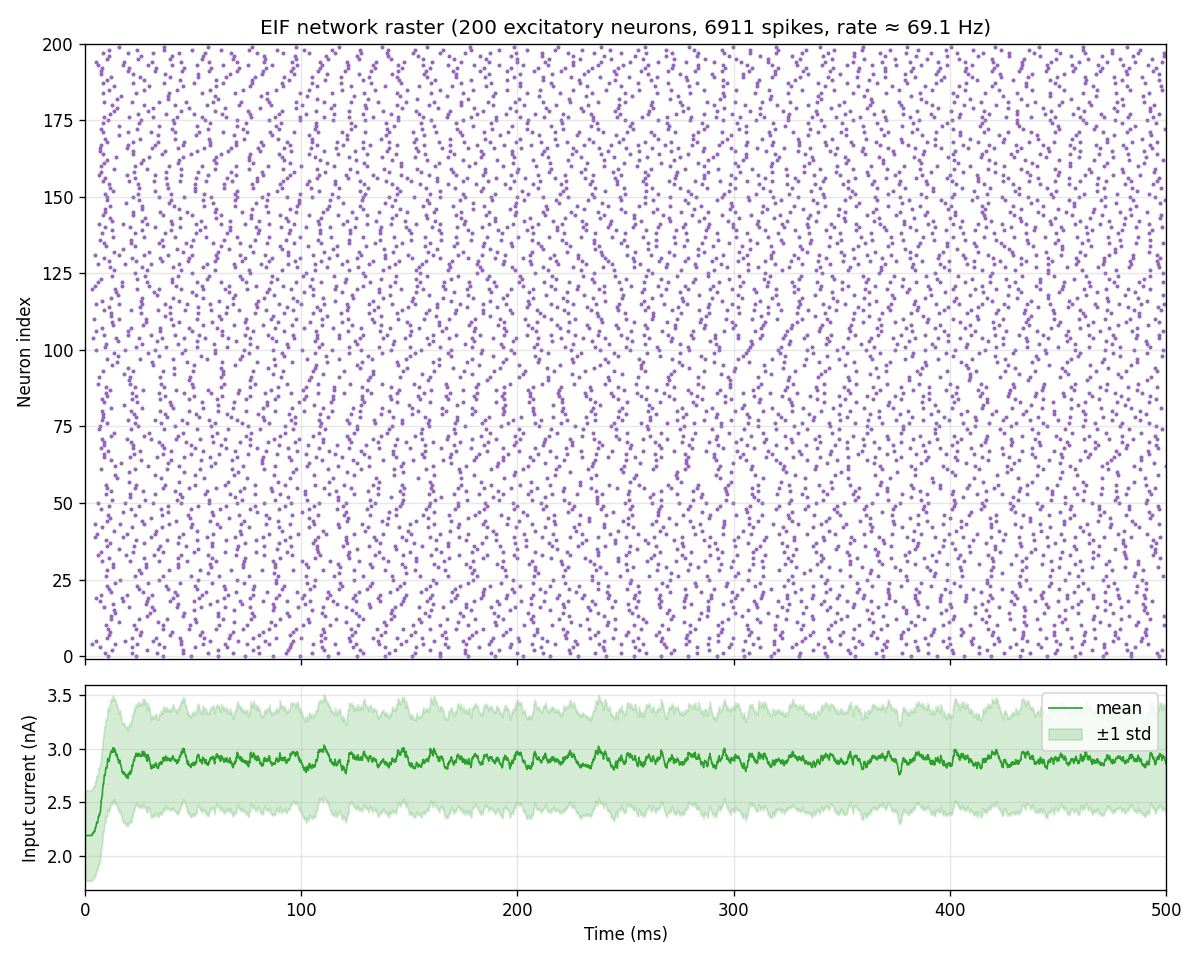
Same plumbing as nb000 — neuron eif and neuron enet produce the figures, the runner copies them and writes numbers.json.
EIF run parameters
| Parameter | Value |
|---|---|
| command | eif |
| current | 2.5 |
| duration | 100.0 |
| dt | 0.1 |
| firing_rate_hz | 60.0 |
EIF network run parameters
| Parameter | Value |
|---|---|
| command | enet |
| n | 200 |
| duration | 500.0 |
| dt | 0.1 |
| seed | 0 |
| mean_firing_rate_hz | 69.11 |
| min_firing_rate_hz | 32.0 |
| max_firing_rate_hz | 98.0 |